Why Every Science Student in Nigeria Needs the Virtual Science Lab Before Their Practical Exams
The WAEC practical examination is worth marks that most science students cannot afford to lose. Chemistry, Physics, and Biology practicals contribute directly to the final grade, and performance in them reflects one thing above all else: how much time a student has spent actually doing experiments.
Most Nigerian secondary school students have not spent enough time doing experiments. Not because they lack the motivation, but because the laboratories are not there.
The Reality of Science Labs in Nigeria
It is not an exaggeration to say that functional laboratory infrastructure is a minority experience in Nigerian secondary education. Virtual science labs have emerged as a practical response to address limitations in physical laboratory facilities and equipment, providing a suitable supplement or primary tool for laboratory experiments in environments where the physical option is unavailable or insufficient.
The consequence for students is concrete. A candidate who has never titrated a solution, never set up an electrical circuit, never prepared a slide for microscopy, arrives at the practical examination at a significant disadvantage compared to one who has. Understanding theory is not the same as knowing what to do with equipment in a room.
What the Virtual Science Lab Offers
The ExamGuide Virtual Science Lab is offered in three distinctive products: Chemistry Lab, Physics Lab, and Biology Lab, giving students and schools a more efficient and enjoyable way of conducting science experiments. The virtual and digital nature of the labs provides users with the option to go paperless during experiments. Students can monitor their progress and results from past and present experiments, enabling them to be better prepared for examinations. Virtual Science Lab works offline, saving cost and time. Teachers and students can also create study groups, interact, and give assignments all from the comfort of their homes.
The offline functionality is significant. A student in an area with unreliable internet can still complete virtual practical sessions on a phone or laptop without a data connection. The lab is available whenever the student is.
The grading system embedded in the platform adds another layer of preparation value. Students receive feedback on their experimental outcomes, not just whether they completed a procedure, but whether they did it correctly. That kind of structured feedback from a physical lab session depends on a teacher being present and attentive. In the virtual lab, it is automatic.
Why This Matters for Exam Performance
WAEC and NECO practical examinations: test procedure, observation, and conclusion. Examiners are not only looking at whether a student got the right answer; they are looking at whether the student followed the correct experimental method. A student who has run through the same practical multiple times in a virtual environment understands the sequence of steps, the common errors, and the expected outcomes in a way that reading about an experiment simply cannot replicate.
The Virtual Science Lab covers most secondary school experiments across all three science subjects. Whether a student is preparing for Chemistry titration, Physics optics, or Biology dissection, the platform provides a repeatable practice environment that the school laboratory, even where it exists, often cannot match in consistency.
Download ExamGuide UTME or SSCE Practice App from www.examguide.com/offline to access the Virtual Science Lab. For science students sitting WAEC or NECO, this is not an optional extra. It is the closest thing to preparation that actually mirrors what the exam will ask you to do.
No comment found
Related Posts

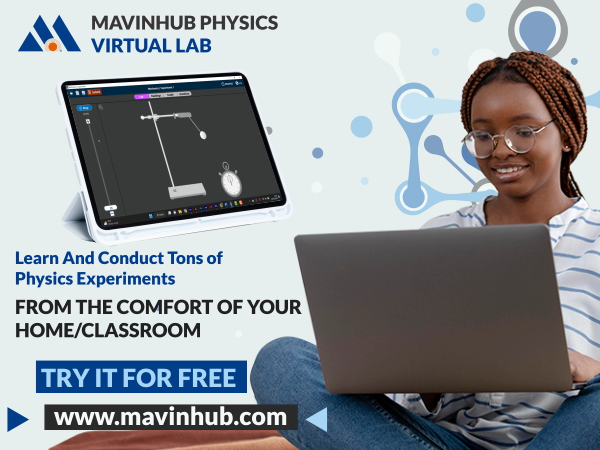
Conduct Physics Practical with MavinHub Virtual Science Lab
HARNESSING THE POWER OF A VIRTUAL SCIENCE LAB