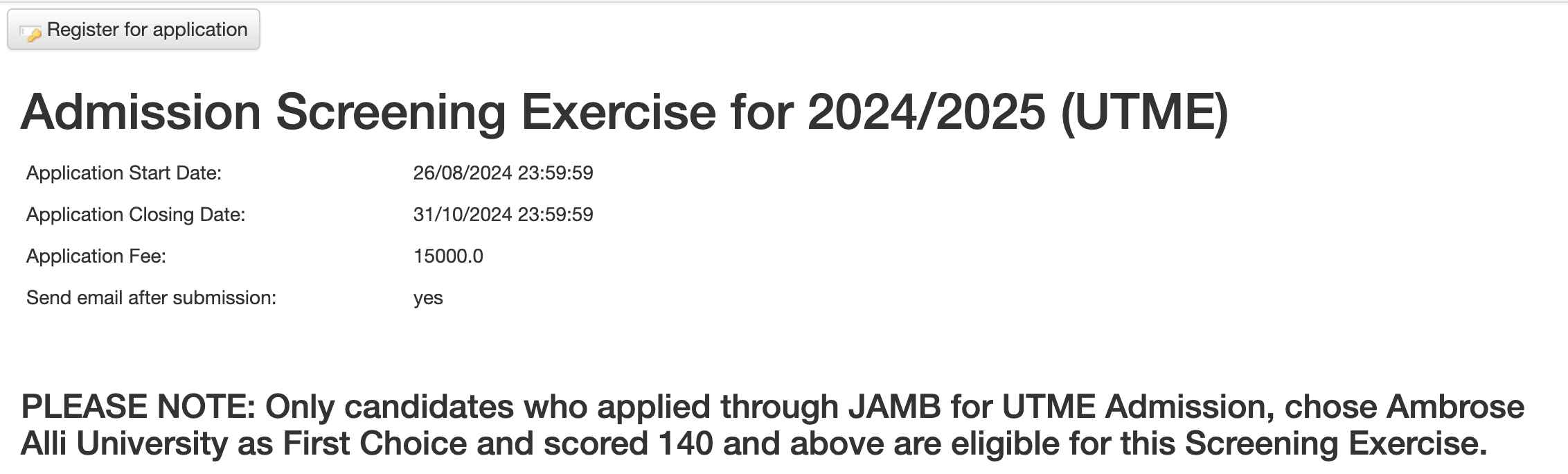
Post-UTME Screening: What It Is, How It Works, and How to Prepare Before Your University Date
Getting your JAMB result is one of the most anticipated moments in a Nigerian student's academic life. But for the vast majority of candidates, that result is not the finish line it is simply the entry ticket to the next, often more decisive, stage: Post-UTME screening.
Every year, students who score impressively in JAMB lose their admission spots to candidates with lower UTME scores because the Post-UTME is where many universities make their final selection. Understanding exactly what Post-UTME involves, how different institutions conduct it, and how to prepare intelligently is not optional information. It is the difference between gaining admission this cycle and waiting another year.
This guide covers everything you need to know.
What Is Post-UTME?
Post-UTME stands for Post-Unified Tertiary Matriculation Examination. It is a screening exercise conducted by Nigerian universities, polytechnics, and colleges of education after the JAMB UTME, used to select the best candidates from those who met the institution's JAMB cut-off mark.
Think of it this way: JAMB determines whether you are qualified to apply to an institution. Post-UTME is the final screening stage that decides whether you will actually be admitted. Many students underestimate this distinction and pay for it with a lost admission cycle.
While JAMB opens the gate, Post-UTME decides who walks through it. The difference between two students with identical JAMB scores often comes down to how one prepared for this second test.
Why Your JAMB Score Alone Is Not Enough
A common misconception is that a high JAMB score guarantees university admission. It does not.
Many schools assign Post-UTME a 40% to 60% weight in their aggregate admission calculation. This means that if your Post-UTME performance is weak, a strong JAMB score may still leave you below the departmental cut-off.
The aggregate score the number that actually determines your admission is calculated from a combination of your JAMB score, your Post-UTME score, and in some cases your O'Level performance. Each institution weights these differently, which is why understanding your specific university's formula matters enormously.
How Different Universities Conduct Post-UTME
One of the most important things to understand early is that Post-UTME is not uniform. Different institutions conduct Post-UTME in different formats.
Here is what the main formats look like:
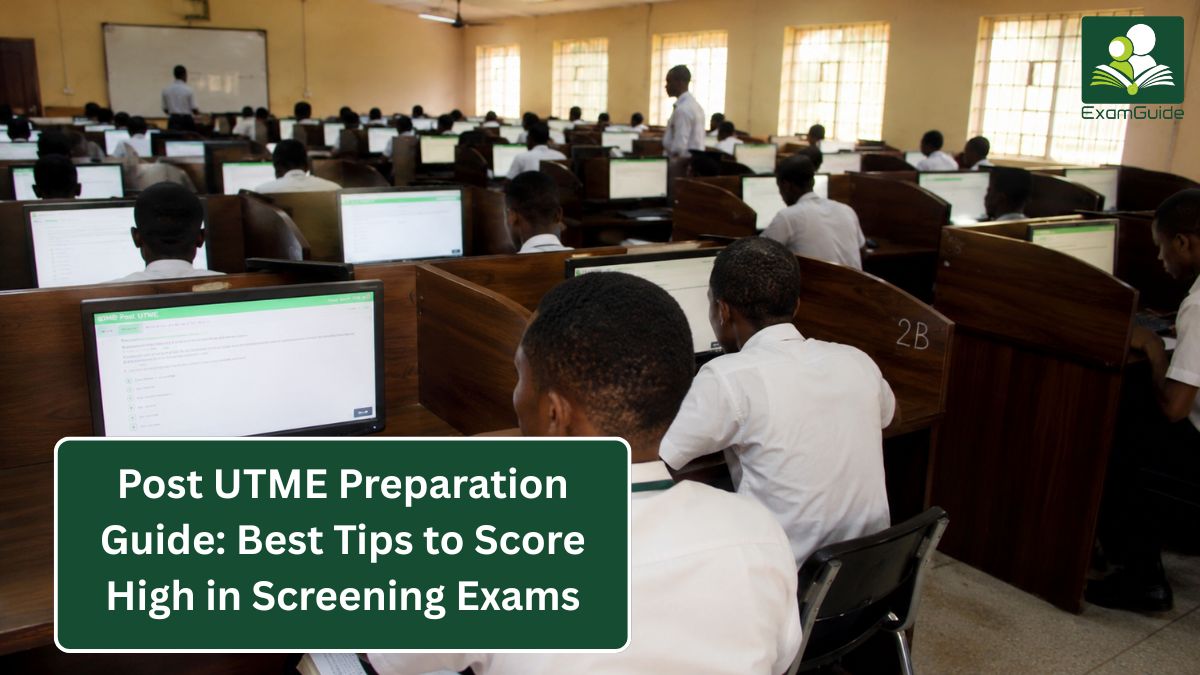
Computer-Based Test (CBT): The most common format across federal universities. Questions are usually drawn from English, Mathematics, and your UTME subject combination. For example, if you applied for Medicine, expect questions from English, Biology, Chemistry, and Physics. Most CBT Post-UTME exams are timed between 30 and 60 minutes, making speed and familiarity with the interface critical.
Aptitude Tests: Some schools test logical reasoning, problem-solving, and general intelligence, including puzzles, sequences, and critical thinking questions.
Online Screening (No Written Exam): Some schools only use online screening, where they consider your JAMB score, O'Level results, and sometimes age or catchment area. No exam is written, but preparation is still required because your documents must be accurate.
Oral Interviews: Less common, but used by certain institutions, particularly for courses like Medicine and Law at some universities.
Examples from major institutions illustrate the variation: UNILAG conducts CBTs strictly based on English Language, Mathematics, and General Paper with time-sensitive questions. The University of Ibadan uses its CBT model but heavily emphasises logic, comprehension, and speed.
UNILAG, for instance, requires candidates to have scored 200 and above in UTME and possess five credit passes at one sitting in relevant O'Level subjects, including English Language and Mathematics.
The practical implication: do not assume your Post-UTME will look like a friend's at a different institution. Research your specific university's format before beginning preparation.
The Registration Process: What to Expect
Post-UTME registration processes vary, but most universities follow a general pattern: candidates register online via the institution's official portal, paying a registration fee, completing a form with their UTME details, and printing an exam pass or scheduling an exam date.
Common mistakes at this stage that candidates must avoid:
- Missing registration deadlines. Some schools close portals abruptly. Monitor your target university's official website and verified social media channels consistently after JAMB results are released.
- Uploading incorrect documents. Blurry or incomplete documents lead to disqualification. Ensure your O'Level results, JAMB result slip, and passport photograph are clear and meet the specified file requirements.
- Using unofficial websites. As Post-UTME registration periods open, fraudulent websites and "agents" claiming to offer guaranteed registration or results appear. Always access the institution's portal directly.
Most universities open Post-UTME registration between July and October, following the release of JAMB results. Registration windows are typically two to four weeks and do not extend, regardless of circumstances.
How Post-UTME Scores Are Combined With JAMB
Understanding the aggregate calculation used by your institution is essential for setting realistic preparation targets.
While the exact formula varies, a common model used by many Nigerian universities combines JAMB and Post-UTME scores with O'Level grades to produce an aggregate out of 100. A simplified version of this:
- JAMB score is converted (e.g., divided by 8 to give a score out of 50)
- Post-UTME score contributes the remaining percentage (e.g., out of 50)
- Some institutions factor O'Level performance into a third component
Under this kind of model, a candidate who scores 260 in JAMB but performs poorly in Post-UTME can easily be outranked by a candidate who scored 230 in JAMB but excelled in Post-UTME. This is why treating Post-UTME as an afterthought is one of the most costly mistakes a candidate can make.
Check the official admission guidelines on your institution's website to find the exact formula they use, or contact the admissions office directly.
How to Prepare for Post-UTME: A Practical Strategy
- Start immediately after JAMB results
The window between JAMB results and Post-UTME screening is shorter than most candidates expect often six to ten weeks. Begin preparation as soon as your result is released, not after registration is complete.
- Research your institution's specific format
Every university has its own Post-UTME style. Knowing your school's format helps you prepare with focus instead of guessing. The best way to find out is by checking your university's official portal, talking to recent aspirants, or reviewing past candidates' feedback.
- Practise past questions extensively
Past questions are the most reliable preparation resource for Post-UTME. Because the examination format is standardised within each institution, past questions reveal the question style, subject weighting, and time pressure you will encounter. Candidates who work through multiple years of their institution's Post-UTME past questions consistently report higher familiarity with the format on examination day, and familiarity directly reduces the anxiety that costs marks.
ExamGuide CBT practice App includes Post-UTME past questions presented in a timed environment that mirrors the actual examination interface. Practising in this format means that by the time you sit the real exam, you are not learning how to navigate the system, you are focused entirely on answering questions. To access this, visit https://examguide.com/offline/products/post-utme
- Set a target score for your course
Knowing your school's cut-off mark is one thing, but you should aim higher. Setting a target score motivates you to put in extra effort and gives you a clear benchmark. Research the departmental cut-off for your specific course, calculate what Post-UTME score you need based on your JAMB result, and use that number to structure your preparation.
- Simulate the time pressure
At UNIPORT, for example, each candidate answers 50 objective questions within 30 minutes, making time management a crucial factor in success. This is not unusual, many Post-UTME exams are significantly shorter than JAMB. A candidate who knows the answers but cannot answer fast enough will still perform poorly. Timed practice sessions are non-negotiable.
- Include current affairs in your preparation (where relevant)
Many schools now include general knowledge or current affairs in their Post-UTME. Questions often touch on Nigerian politics, history, and global events. Check whether your institution includes this component and allocate study time accordingly.
- Take care of your health and mental state in the final days
This is frequently overlooked but genuinely matters. Good health fuels good performance. Sleep well, eat balanced meals, and take breaks when studying. A tired brain will not recall what you studied. The final week before Post-UTME is not the time to begin intensive cramming it is the time to consolidate what you have already practised.
On Examination Day
A few practical points that apply regardless of institution:
At the venue, focus on your screen or paper alone. Ignore distractions or whispers. Take deep breaths before starting. Confidence comes from preparation, not luck.
If you encounter a technical issue during a CBT exam a slow system, a screen freeze, a connectivity problem do not panic. Alert an invigilator immediately and document the issue. Most institutions have protocols for handling technical disruptions.
Print your exam pass before the day. Carry a valid means of identification. Arrive early enough to locate your exam centre or desk without rushing. These small logistical details have ended more than a few students' admission cycles through no fault of their academic preparation.
What Happens After Post-UTME
Results are typically released a few days to two weeks after the screening exercise, via the institution's portal. Following results, institutions process admission through JAMB's Central Admissions Processing System (CAPS), where successful candidates will find their admission status and can accept or decline offers.
Monitor your JAMB CAPS account and your institution's portal simultaneously after Post-UTME results are released. Do not rely on third-party websites or social media posts for admission status updates; always verify directly through official channels.
The Role ExamGuide Plays at This Stage
The Post-UTME stage is where many students who prepared well for JAMB lose ground, not because they lack the knowledge, but because they have not practised in the right format under the right conditions.
ExamGuide past questions CBT simulation t are directly designed for this challenge. Whether you are preparing for the UNILAG aptitude test, UI's CBT, UNIPORT's timed screening, or the Post-UTME at any state university, consistent practice in an examination-mirroring environment builds the speed, accuracy, and composure that Post-UTME demands.
The candidates who secure admission are not always the ones who scored the highest in JAMB. They are the ones who took Post-UTME seriously, prepared specifically, and walked in having already proven their readiness to themselves through practice.
Final Word
Your JAMB result opens the door. Post-UTME determines whether you step through it.
Treat this stage with the same or greater seriousness as your UTME preparation. Research your institution's specific format, start early, practise in timed CBT conditions, and set your aggregate target before your first practice session. The students who follow this approach do not just pass Post-UTME, they pass it with enough margin to secure the course and institution they actually want.
Preparing for Post-UTME? Access institution-specific past questions and practice in a timed CBT environment on ExamGuide and walk into your screening already prepared. https://examguide.com/offline/products/post-utme
No comment found
Related Posts

Post-UTME Season Is Coming. How to Start Preparing Before Your School Announces Dates.
Post UTME Preparation Guide: Best Tips to Score High in Screening Exams

UNIOSUN Post UTME Result for 2024/2025 is Out - CHECK NOW

UNIMED Supplementary Post UTME Form 2025/2026 Application Update

YABATECH Post UTME Form 2025-26: How to Apply and Important Updates