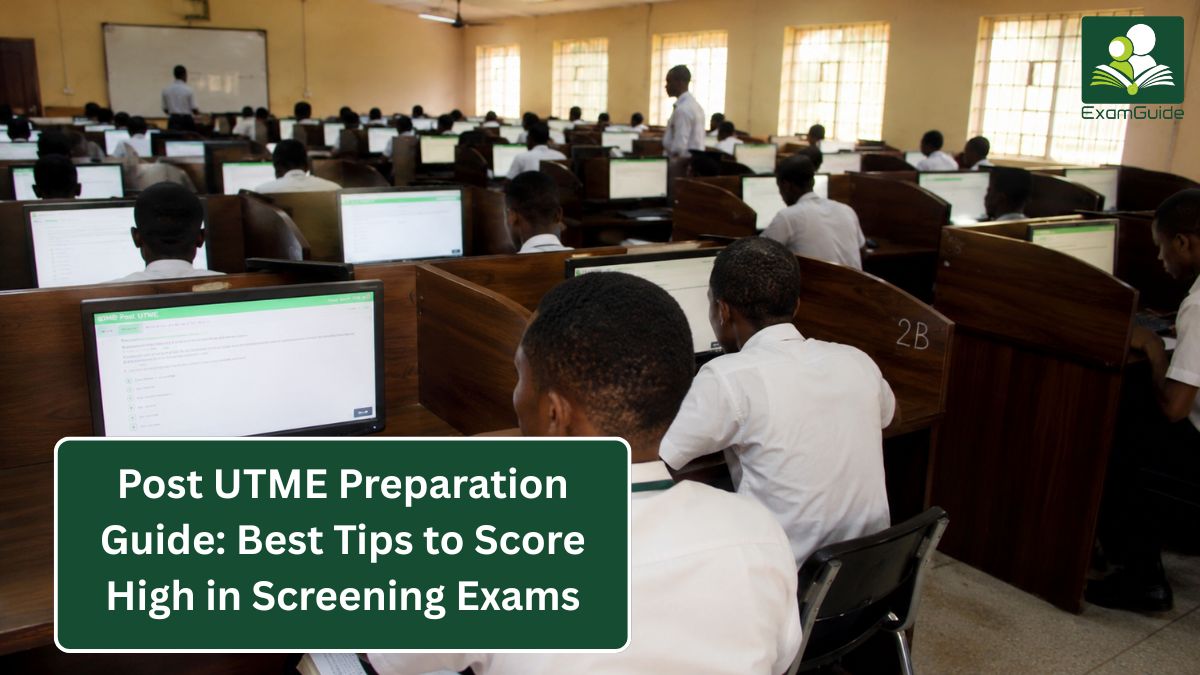
Post UTME Preparation Guide: Best Tips to Score High in Screening Exams
For many Nigerian students, scoring well in JAMB is only the first step toward securing admission into their preferred university. After the Unified Tertiary Matriculation Examination, candidates must still go through the Post UTME screening process conducted by individual institutions. While some universities conduct Computer Based Tests, others combine O'Level results, JAMB scores, and screening exercises to determine admission eligibility.
Because admission spaces are limited and competition is high, Post UTME preparation is just as important as JAMB UTME preparation. Many candidates assume that a good UTME score automatically guarantees admission, only to perform poorly during screening and lose admission opportunities.
The reality is that Post UTME examinations are designed to further assess a candidate's readiness for university education. Students who understand the screening process, practice consistently, and prepare strategically often have a significant advantage over those who rely solely on their JAMB UTME performance.
This guide explains how candidates can prepare effectively, improve their chances of success, and maximize their scores during Post UTME screening exercises.
Table of Content
What Is Post UTME and Why Is It Important?
How Do Universities Conduct Post UTME Screening?
Why Do Many Candidates Perform Poorly in Post UTME Despite Scoring High in JAMB UTME?
What Should You Know About Your University's Post UTME Pattern?
How to Create a Post UTME Study Plan That Works
How Important Is CBT Practice for Post UTME Success?
Common Mistakes Candidates Make During Post UTME Preparation
How Can Candidates Improve Their Chances If Their JAMB UTME Score Is Not Very High?
What Should Candidates Do During the Final Week Before Post UTME?
Exam Day Strategies That Can Improve Performance
How ExamGuide Helps Candidates Prepare for Post UTME
What Is Post UTME and Why Is It Important?
Post UTME is a screening process conducted by tertiary institutions after JAMB. It serves as an additional evaluation stage that helps universities select candidates for admission.
Different institutions conduct their screenings differently. Some universities organise Computer Based Tests, while others use online screening processes that consider JAMB scores, O'Level grades, and other admission requirements.
The importance of Post UTME cannot be overstated. A candidate with a strong JAMB UTME score may still miss admission if they perform poorly during screening. Likewise, candidates with average JAMB scores can sometimes improve their admission chances by performing exceptionally well in Post UTME.
Understanding how your chosen institution conducts its screening is one of the first steps toward effective preparation.
Students preparing for Post UTME can strengthen their examination readiness through structured CBT practice here → Practice With ExamGuide
How Do Universities Conduct Post UTME Screening?
One of the biggest mistakes candidates make is assuming that all universities use the same screening format.
In reality, screening procedures vary across institutions. Some universities conduct traditional Computer Based Tests that include questions from subjects related to a candidate's intended course of study. Others use online screening methods where candidates upload their credentials and are assessed based on aggregate scores.
Certain institutions combine JAMB UTME scores, Post UTME scores, and O'Level results to determine admission eligibility. Others place greater emphasis on one component than another.
Candidates should therefore visit the official admission portal of their chosen institution and carefully study the screening process. Knowing what to expect allows students to prepare more effectively and avoid surprises.
Why Do Many Candidates Perform Poorly in Post UTME Despite Scoring High in JAMB UTME?
Every admission cycle produces candidates who score very well in JAMB but struggle during Post UTME.
One reason is overconfidence. Some students stop studying after receiving a good JAMB UTME result, believing admission is already guaranteed. This often leads to inadequate preparation for the next stage.
Another reason is unfamiliarity with institution specific screening patterns. Questions may differ from what candidates encountered during JAMB, and universities often emphasize different topics.
Poor time management also contributes to low performance. Candidates who are not familiar with CBT environments may waste valuable time navigating questions instead of answering them.
Additionally, many students fail to revise foundational concepts after JAMB UTME. Months may pass between JAMB UTME and Post UTME, leading to forgotten topics and reduced confidence.
What Should You Know About Your University's Post UTME Pattern?
Every candidate should research their institution's screening pattern before beginning serious preparation.
Important questions to answer include:
- Does the university conduct a CBT examination?
Candidates should determine whether the institution uses a Computer Based Test or an online screening process.
- What subjects are tested?
Many institutions test subjects directly related to the candidate's intended course of study.
- How many questions are usually asked?
Knowing the typical question volume helps candidates practice effectively.
- How much time is allocated?
Time limits vary between institutions and significantly influence preparation strategy.
- How are scores calculated?
Some universities combine JAMB UTME scores, Post UTME scores, and O'Level grades to generate aggregate scores.
Candidates who understand these details can tailor their preparation to meet the specific demands of their institution.
Start preparing for Post UTME here → ExamGuide Post UTME
How to Create a Post UTME Study Plan That Works
A study plan provides structure and direction during preparation.
Without a plan, candidates often spend too much time on familiar topics while neglecting weak areas. A structured timetable helps ensure comprehensive coverage and balanced preparation.
An effective Post UTME study plan should include subject review, CBT practice, revision sessions, and performance evaluation.
The timetable should also reflect individual strengths and weaknesses. Subjects that present challenges should receive additional attention without neglecting stronger areas.
Consistency remains one of the most important factors in Post UTME success. Candidates who study regularly over several weeks usually perform better than those who rely on last minute preparation.
1. Set a Target Score Based on Your Course and Institution
Candidates should begin preparation with a clear goal.
Competitive courses such as Medicine, Pharmacy, Law, Engineering, and Nursing often require higher admission scores than less competitive programmes.
Understanding the admission realities of your chosen course helps create realistic targets and motivates focused preparation.
When students have a clear score target, they are often more disciplined and strategic in their study efforts.
2. Study the Subjects Relevant to Your Course
Post UTME preparation should focus primarily on subjects that are directly related to the candidate's intended course of study.
Science candidates should concentrate on subjects such as Biology, Chemistry, Physics, and Mathematics where applicable. Arts and Social Science candidates should focus on relevant subject combinations.
Candidates should revisit key concepts, formulas, definitions, and frequently tested topics rather than attempting to relearn entire subjects from scratch.
A focused approach improves efficiency and reduces unnecessary stress during preparation.
3. Use Past Questions Strategically
Past questions remain one of the most effective tools for Post UTME preparation because they help candidates understand examination patterns and identify areas that receive consistent attention.
Many universities tend to focus on certain topics repeatedly, even when the questions are not exactly the same. Candidates who practice past questions regularly become familiar with the style of questions, the level of difficulty, and the topics that are frequently tested.
However, using past questions effectively requires more than simply reading through answers. Candidates should attempt questions independently, review their mistakes carefully, and understand why the correct answers are correct. This approach strengthens understanding and improves retention.
Post UTME practice becomes more effective when questions are organised and accompanied by explanations. You can begin practising here → ExamGuide Post UTME
4. Practice With CBT Platforms Regularly
Most universities that conduct Post UTME examinations use Computer Based Testing. As a result, candidates must be comfortable with the CBT environment before examination day.
Many students know the answers to questions but lose marks because they struggle with navigation, time management, or computer based testing interfaces. Regular CBT practice helps eliminate this problem.
Practising with CBT platforms improves familiarity with answering questions on a computer, selecting options correctly, moving between questions, and managing examination time effectively.
The more exposure candidates have to CBT simulations, the more confident they become during the actual examination.
5. Focus on Accuracy Before Speed
One mistake candidates often make is trying to answer questions too quickly.
While speed is important, accuracy should come first. Answering questions rapidly but incorrectly does not improve scores. Candidates should first develop a strong understanding of concepts and focus on getting questions right consistently.
As understanding improves, speed will naturally increase through regular practice.
Candidates who balance speed and accuracy effectively are usually better positioned to perform well during Post UTME examinations.
6. Learn Effective Time Management Techniques
Time management is one of the most important skills in any screening examination.
Many candidates know the answers to questions but fail to complete the examination because they spend too much time on difficult questions. Others rush through the examination and make careless mistakes.
An effective strategy is to answer straightforward questions first and return to more difficult questions later. This helps secure easy marks while reducing unnecessary pressure.
Candidates should also practise under timed conditions regularly so they become comfortable working within examination limits.
7. Review Weak Areas Consistently
Every candidate has areas of strength and areas that require improvement.
One of the biggest mistakes students make is focusing only on subjects they enjoy. While it is important to maintain strengths, significant improvement often comes from addressing weaknesses.
Candidates should regularly assess their performance and identify topics where they consistently make mistakes. These areas should receive additional attention during revision.
Improvement becomes easier when weaknesses are identified early and addressed systematically.
How Important Is CBT Practice for Post UTME Success?
CBT practice has become increasingly important because most universities now conduct their screening examinations electronically.
Beyond academic knowledge, candidates need to be comfortable using computers under examination conditions. This includes reading questions on screen, navigating between sections, managing time effectively, and submitting answers correctly.
Students who practise CBT regularly often enter the examination hall with greater confidence because the testing environment feels familiar.
Parents can support candidates by encouraging consistent CBT practice throughout the preparation period rather than waiting until a few days before the examination.
Common Mistakes Candidates Make During Post UTME Preparation
Many students work hard but still struggle because of avoidable mistakes.
Some begin preparation too late and attempt to cover months of revision within a few weeks. Others spend too much time reading notes without practising questions.
Another common mistake is relying entirely on JAMB preparation materials without understanding the specific requirements of their chosen institution. Universities often have unique screening patterns, and preparation should reflect those differences.
Overconfidence can also be a problem. A high JAMB score does not guarantee success in Post UTME. Every stage of the admission process deserves serious preparation.
Candidates who avoid these mistakes improve their chances of performing well and securing admission.
How Can Candidates Improve Their Chances If Their JAMB UTME Score Is Not Very High?
A lower than expected JAMB score does not automatically mean admission is impossible.
Many institutions consider multiple factors during admission, including Post UTME performance and O'Level results. Candidates who perform exceptionally well in Post UTME can sometimes improve their aggregate scores significantly.
The key is to focus on factors that remain within your control. Strong Post UTME preparation, careful subject revision, and consistent practice can make a meaningful difference.
Rather than dwelling on previous results, candidates should focus on maximising their performance during the screening stage.
What Should Candidates Do During the Final Week Before Post UTME?
The final week before the examination is important, but it should not be used for panic reading.
At this stage, candidates should focus on revision rather than attempting to learn entirely new topics. Key formulas, definitions, concepts, and frequently tested areas should receive attention.
Practice examinations under timed conditions can help build confidence and identify any remaining weak areas.
Adequate rest is equally important. Sleep, nutrition, and mental preparation contribute significantly to examination performance.
Candidates should also confirm their examination venue, time, and required documents before the examination day.
Exam Day Strategies That Can Improve Performance
Preparation alone is not enough. Candidates must also apply effective strategies during the examination itself.
Arriving early at the examination centre helps reduce stress and allows time to settle in before the examination begins.
Candidates should read instructions carefully before answering questions. Misunderstanding instructions can lead to unnecessary mistakes.
Time should be monitored throughout the examination to ensure all questions receive attention. Difficult questions should not consume excessive time.
Most importantly, candidates should remain calm. Anxiety often leads to mistakes, even among well prepared students.
How ExamGuide Helps Candidates Prepare for Post UTME
ExamGuide provides candidates with practical tools designed to improve Post UTME preparation and performance.
Students can access structured questions, CBT practice environments, detailed explanations, and resources that support effective revision.
The platform helps candidates identify weak areas, improve confidence, and become familiar with examination conditions before the actual screening exercise.
Instead of studying randomly, candidates follow a more organised and measurable preparation process.
Prepare for Post UTME with structured CBT practice and question banks here → ExamGuide Post UTME
Conclusion
Post UTME remains one of the most important stages in the university admission process. While JAMB provides the first opportunity to demonstrate academic ability, the screening exercise often plays a major role in determining admission outcomes.
Candidates who prepare strategically, practise consistently, and understand their institution's screening pattern place themselves in a stronger position for success. Effective preparation involves more than reading textbooks. It requires CBT practice, time management, revision, and a clear understanding of examination expectations.
Parents also have an important role to play by providing support, encouragement, and a conducive learning environment throughout the preparation period.
With the right strategy and consistent effort, candidates can approach Post UTME confidently and improve their chances of securing admission into their preferred institution.
Frequently Asked Questions
1. What is Post UTME?
Post UTME is a screening process conducted by universities and other tertiary institutions after JAMB to assess candidates for admission.
2. Is Post UTME compulsory?
For institutions that conduct screening examinations, participation is usually required before admission can be considered.
3. Can a high JAMB score guarantee admission?
Not always. Many institutions also consider Post UTME performance and other admission requirements.
4. How should I prepare for Post UTME?
Create a study timetable, revise relevant subjects, practise CBT questions, and use past questions consistently.
5. Are past questions important?
Yes. They help candidates understand examination patterns and improve familiarity with question styles.
6. How important is CBT practice?
CBT practice is very important because many institutions conduct computer based screening examinations.
7. How many hours should I study daily?
The number of hours varies, but consistent and focused study is generally more effective than long, irregular study sessions.
8. What should I do if my JAMB UTME score is low?
Focus on performing strongly in Post UTME and meeting other admission requirements.
9. How can parents help candidates prepare?
Parents can provide support, encouragement, and a suitable environment for studying.
10. How does ExamGuide support Post UTME preparation?
ExamGuide provides CBT practice, structured questions, explanations, and tools that help candidates prepare effectively for screening examinations.
No comment found
Related Posts

Post-UTME Season Is Coming. How to Start Preparing Before Your School Announces Dates.

Post-UTME Screening: What It Is, How It Works, and How to Prepare Before Your University Date

UNIOSUN Post UTME Result for 2024/2025 is Out - CHECK NOW

UNIMED Supplementary Post UTME Form 2025/2026 Application Update
YABATECH Post UTME Form 2025-26: How to Apply and Important Updates