

50000 NECO Fee for 2027: Education Advocates Reject Proposed N50,000 Registration Fee, Demand Review
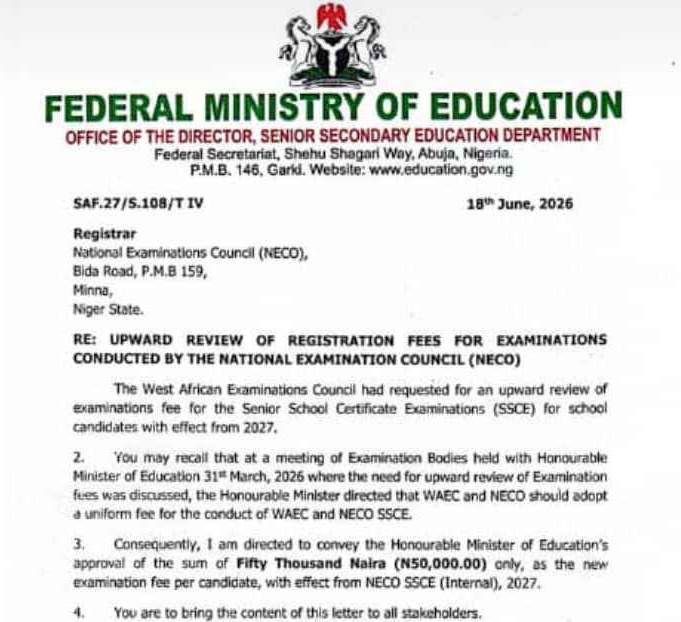
The Federal Government’s approval of a proposed increase in the National Examinations Council (NECO) Senior School Certificate Examination (SSCE) registration fee to N50,000 has sparked concerns among education stakeholders, who say the move could place further financial pressure on Nigerian families already struggling with rising living costs.
According to a circular dated June 18, 2026, signed by the Director of Senior Secondary Education at the Federal Ministry of Education, the new fee structure is expected to take effect from the 2027 NECO SSCE (Internal) examination.
The ministry explained that the adjustment followed a request from the West African Examinations Council (WAEC) and a directive from the Minister of Education to harmonise examination fees across the two major senior secondary school examination bodies.
However, critics have described the decision as a major setback for educational accessibility, arguing that the timing of the increase does not reflect the economic realities facing many Nigerian households.
With the current minimum wage fixed at N70,000, education advocates noted that requiring parents to pay N50,000 for a single examination candidate would consume a significant portion of a worker’s monthly income.
For families with two or more children preparing for the examination, the financial burden can become overwhelming, especially amid rising costs of food, transportation, school materials, and other basic needs.
Preparing to sit for NECO? Download ExamGuide SSCE Practice App from https://examguide.com/offline/products/ssce
One critic of the policy argued that “education should not become a privilege reserved for families who can afford it,” warning that the fee increase could push many students from low-income backgrounds away from completing their secondary education.
While the Federal Government’s decision to harmonise WAEC and NECO fees may aim to create uniformity in the examination system, stakeholders insist that this move should not increase barriers for students.
They stressed that the government has a responsibility to protect access to education and ensure that economic challenges do not determine which students can sit for critical examinations.
Some stakeholders have called on the government to review the proposed fee and consider subsidising part of the examination cost. They suggested that candidates should not be required to pay beyond N20,000, with the government supporting examination bodies to maintain quality and credibility.
They also urged greater transparency from examination authorities regarding the use of examination fees, noting that accountability would help justify any necessary adjustments.
The controversy comes at a time when Nigeria continues to battle inflation and economic hardship, with many parents already struggling to meet the cost of education.
Preparing to sit for NECO? Download ExamGuide SSCE Practice App from https://examguide.com/offline/products/ssce
Stakeholders have therefore appealed to the Ministry of Education to engage parents, schools, examination bodies and civil society organisations before implementing the new fee structure.
They warned that increasing the NECO SSCE registration fee to N50,000 without considering the financial realities of ordinary Nigerians could undermine efforts to improve human capital development and expand educational opportunities.
As the 2027 implementation date approaches, calls are growing for a reconsideration of the policy to ensure that no student is denied the opportunity to obtain a senior secondary school certificate because of financial constraints.
No comment found
Related Posts

Nursing Admission: Failed WAEC Subjects, Pending NECO Results Leave Candidates Uncertain of Getting Admitted

2026 WAEC Results Crisis Deepen as Senior Official Allegedly Confirms Irregularities, Glitches

NYSC, JAMB Move to Introduce New Framework to Make Candidates Data Changes Seamless

Starfield College Celebrates 2026 Outstanding Students that Scored 8As, 7As in WASSCE, UTME scores of 327, 326, 321

JAMB Directs Colleges of Education to Submit Lists of Illegally Admitted Students for Condonement
