BECE Subjects Guide: What Students Must Read and How to Prepare Effectively
Preparing for the Basic Education Certificate Examination (BECE) is one of the most important academic stages for junior secondary school students. It is the bridge between foundational learning and senior secondary education, and performance in this exam often determines future academic opportunities.
Many students approach BECE with effort but without direction. They read widely but not strategically, memorise without understanding, and practice inconsistently. As a result, they struggle to perform at their best despite spending long hours studying.
For parents, it can also be challenging to know how to properly guide their children through this stage. Questions often arise about what subjects to focus on, how to structure reading, and how to ensure effective preparation.
This guide is designed to provide clarity. It explains the subjects students must prepare for, how to study them effectively, and how to use proven strategies such as past questions and structured practice to improve performance.
Table of Content
Understanding BECE Subjects and Their Importance
What Subjects Are Written in the BECE Exam?
How Many Subjects Must a Student Pass in BECE?
What Subjects Should BECE Students Focus On Most?
How to Prepare Each BECE Subject Effectively
Structure of BECE Subjects and Question Format
Why Past Questions Are Essential for BECE Success
Identifying Repeated Topics and Exam Patterns
Why Memorisation Alone Is Not Enough
Building Confidence Before the BECE Examination
Common Mistakes BECE Students Should Avoid
How ExamGuide Supports BECE Preparation
Understanding BECE Subjects and Their Importance
The BECE covers a wide range of subjects designed to test a student’s overall academic ability. While subject combinations may vary slightly depending on the examination body, the core subjects remain consistent.
Students are typically required to write subjects such as English Studies, Mathematics, Basic Science, Basic Technology, Social Studies, Civic Education, Cultural and Creative Arts, and one or more Nigerian languages.
Each subject plays a specific role in assessing a student’s competence. English and Mathematics form the foundation of communication and logical reasoning. Science related subjects test analytical thinking, while social and civic subjects evaluate understanding of society and responsibilities.
Understanding the structure and importance of each subject is the first step toward effective preparation. Students who are clear about what each subject demands are better positioned to focus their efforts appropriately.
To strengthen subject understanding and begin structured preparation for BECE early, you can use this platform → Download ExamGuide BECE
What Subjects Are Written in the BECE Exam?
Understanding the subjects offered in BECE is essential for proper preparation. Many students study without clarity on subject requirements, which leads to incomplete preparation and poor performance.
The Basic Education Certificate Examination is taken at the end of Junior Secondary School and covers a broad range of subjects based on the national curriculum. Candidates are required to register for a minimum of eleven subjects and a maximum of thirteen subjects, depending on their school and examination body.
These subjects are grouped into core, composite, and elective categories, and each plays a role in assessing a student’s academic readiness.
1. Core Compulsory Subjects
These are the foundational subjects that every BECE candidate must offer.
English Studies
This subject tests comprehension, grammar, and writing ability. It is one of the most important subjects because it affects performance in all other subjects.
Mathematics
Mathematics evaluates logical reasoning and problem solving skills. It requires consistent practice and understanding of formulas.
Basic Science and Technology (BST)
This is a combined subject that includes Basic Science, Basic Technology, Computer Studies, and Physical and Health Education. It tests scientific understanding and practical knowledge.
National Value Education (NVE)
This subject combines Civic Education, Social Studies, Security Education, and Religious Studies. It focuses on values, responsibilities, and societal understanding.
Pre-Vocational Studies (PVS)
This includes subjects like Agriculture and Home Economics. It introduces students to practical life and vocational skills.
Cultural and Creative Arts (CCA)
This subject covers music, fine arts, and cultural knowledge. It tests creativity and cultural awareness.
These core subjects form the foundation of the BECE and must be taken by all candidates.
2. Language Subjects
Students are required to offer at least one language subject.
Nigerian Languages
Students choose one from languages such as Yoruba, Igbo, Hausa, Efik, or others depending on their region.
Foreign Languages
French is commonly offered, while some schools may offer Arabic as an alternative.
Language subjects test communication skills and cultural understanding.
3. Business and Vocational Subjects
These subjects focus on practical knowledge and foundational business skills.
Business Studies
Covers commerce, bookkeeping, and basic entrepreneurship concepts.
These subjects help students develop skills that are useful beyond the classroom.
4. Religious Studies Options
Students are usually required to choose one based on their background.
Christian Religious Studies (CRS)
Islamic Studies (IRS)
These subjects test moral understanding and religious knowledge.
5. Additional and Optional Subjects
Depending on the school or examination body, students may also offer:
- History
- Arabic Language
- Other vocational or cultural subjects
These subjects provide flexibility and allow students to broaden their academic exposure.
How Many Subjects Must a Student Pass in BECE?
To be considered successful in BECE, a student is typically expected to pass at least six subjects, including English Studies and Mathematics, as these are compulsory for progression into senior secondary school.
However, understanding what “passing” means in BECE goes beyond just the number of subjects. It is also about meeting the minimum academic requirement for advancement and ensuring balanced performance across key areas.
1. Minimum Number of Subjects to Pass
BECE candidates usually register for between eleven and thirteen subjects, depending on their school and examination body.
Out of these, a student must obtain passes in at least six subjects to be considered successful. This requirement ensures that the student has a broad level of competence across different subject areas.
2. Compulsory Subjects That Must Be Passed
Among the subjects written, English Studies and Mathematics are compulsory passes.
These two subjects are critical because:
- English is the language of instruction for most subjects
- Mathematics reflects logical and analytical ability
Failure in either of these subjects can affect a student’s ability to progress, even if other subjects are passed.
3. What Counts as a “Pass” in BECE
BECE uses a grading system where students are assessed based on their performance in each subject.
Generally, a pass indicates that the student has achieved a basic level of understanding required for that subject. Grades such as credit or pass are considered acceptable, while failure indicates insufficient understanding.
4. Importance of Balanced Performance
Passing six subjects is the minimum requirement, but students are encouraged to aim for stronger performance across all subjects.
A student who performs well in more subjects has:
- Better academic confidence
- More flexibility in subject selection in senior secondary school
- A stronger foundation for future exams
You can prepare more effectively for BECE and track your progress across subjects here → Download ExamGuide BECE
What Subjects Should BECE Students Focus On Most?
While all subjects are important, students must understand that not all subjects require the same level of attention at the same time.
Core subjects such as English Studies and Mathematics should receive consistent focus because they are essential for progression into senior secondary school. Weak performance in these subjects can limit future opportunities.
Science related subjects such as Basic Science and Basic Technology require understanding rather than memorisation. Students must focus on concepts, diagrams, and application based questions.
Subjects like Social Studies and Civic Education require a combination of understanding and retention. Students should focus on key themes, definitions, and real life applications.
Balancing all subjects properly is essential. Ignoring weaker subjects or over focusing on stronger ones can affect overall performance.
How to Prepare Each BECE Subject Effectively
Preparing for BECE requires a subject by subject approach. Each subject has its own demands, and understanding how to study each one properly will improve overall performance.
1. English Studies
English is a core subject that tests comprehension, grammar, and writing ability. Students should focus on reading passages, answering comprehension questions, and practicing essay writing. Regular reading improves vocabulary and understanding, while consistent practice helps students express their ideas clearly.
2. Mathematics
Mathematics requires consistent practice rather than occasional reading. Students should solve different types of problems daily and understand the steps involved in arriving at answers. Paying attention to formulas, calculations, and accuracy is important, as small mistakes can affect overall performance.
3. Basic Science
Basic Science focuses on understanding concepts and applying them to real life situations. Students should study topics carefully, understand key ideas, and practice questions that test application. Diagrams and explanations are also important in this subject.
4. Basic Technology
This subject involves practical knowledge and understanding of basic technical concepts. Students should focus on diagrams, tools, and processes. Understanding how things work is more important than memorising definitions.
5. Social Studies
Social Studies requires understanding of society, culture, and relationships. Students should focus on key topics, definitions, and explanations. Relating topics to real life situations helps improve understanding and retention.
6. Civic Education
Civic Education tests knowledge of rights, responsibilities, and societal values. Students should understand key concepts and be able to explain them clearly. This subject requires both understanding and the ability to express ideas properly.
7. Cultural and Creative Arts
This subject combines theory and creativity. Students should understand basic concepts, artistic elements, and cultural topics. Practice and exposure to examples can improve performance.
A balanced approach across all subjects ensures that students do not neglect any area while preparing effectively.
Structure of BECE Subjects and Question Format
Most BECE subjects are designed to test both knowledge and application, which is why they are structured into two main components.
The first component is the objective section, which consists of multiple choice questions. This section tests a student’s ability to recall facts, recognise correct answers, and think quickly under time pressure.
The second component is the theory section, which requires written answers. Students are expected to explain concepts and present their answers clearly.
Some subjects may also include practical or diagram based questions, especially in Basic Science and Basic Technology.
Because of this structure, effective preparation must include both objective practice and theory understanding.
Why Past Questions Are Essential for BECE Success
Past questions are one of the most powerful tools for exam preparation because they provide insight into how examinations are structured and what to expect.
1. They Reveal Question Patterns
Examination bodies often repeat topics and question formats over the years.
2. They Help Identify Important Topics
Some topics appear more frequently than others.
3. They Improve Speed and Accuracy
Regular practice helps students answer questions faster.
4. They Build Exam Confidence
Students become familiar with exam format and expectations.
5. They Expose Weak Areas
Mistakes reveal areas that need improvement.
6. They Encourage Active Learning
Practice improves understanding and retention.
To practice past questions for BECE in a structured and effective way, you can begin here → Download ExamGuide BECE
Identifying Repeated Topics and Exam Patterns
Examinations are not completely unpredictable. Over time, certain topics appear repeatedly because they are fundamental to the subject.
Students who study past questions carefully begin to notice these patterns. This allows them to focus more on high value topics that are likely to appear in the exam.
However, this does not mean ignoring other topics. It means giving priority to areas that have a higher probability of being tested.
A structured system that organises questions by topic makes it easier to identify these patterns and prepare effectively.
You can explore structured topic based practice for BECE here → Download ExamGuide BECE
Why Memorisation Alone Is Not Enough
Many students rely heavily on memorisation, believing it is the fastest way to prepare.
While memorisation can be useful for certain subjects, it is not sufficient for overall success. BECE questions often require understanding and application.
Students who memorise without understanding struggle when questions are presented differently.
A better approach is to focus on understanding concepts and practicing how to apply them. This leads to better retention and improved performance.
Building Confidence Before the BECE Examination
Confidence is a result of preparation.
Students who have covered the syllabus, practiced consistently, and reviewed their mistakes are more likely to approach the exam with confidence.
Lack of preparation often leads to anxiety and poor performance.
Parents play an important role in building confidence by providing encouragement and creating a supportive environment.
Students should also maintain a routine that includes proper rest and balanced study.
Common Mistakes BECE Students Should Avoid
Many students lose marks due to avoidable mistakes.
Some study without a plan and fail to cover the syllabus completely. Others avoid difficult subjects and focus only on areas they are comfortable with.
Some students practice questions without reviewing their mistakes, which limits improvement.
Others wait until the exam is close before they start serious preparation.
Avoiding these mistakes requires early planning, consistent practice, and a structured approach.
How ExamGuide Supports BECE Preparation
ExamGuide provides a structured and effective system for BECE preparation.
It allows students to practice past questions by topic, access detailed explanations, and track their progress over time.
This helps students identify weak areas and improve consistently.
Instead of studying without direction, students follow a clear path that improves understanding, confidence, and performance.
Improve your preparation for BECE here → Download ExamGuide BECE
Conclusion
Preparing for BECE requires more than effort. It requires direction, structure, and consistency.
Students who understand their subjects, practice regularly, and focus on improvement are more likely to succeed. Parents also play an important role in guiding and supporting students through this process.
With the right approach and the right tools, students can prepare effectively and perform confidently in the examination.
Frequently Asked Questions
- What subjects are compulsory for BECE?
English Studies, Mathematics, Basic Science, Social Studies, and other core subjects are compulsory. - How early should I start preparing?
Preparation should begin months before the exam. - Are past questions important?
Yes, they help you understand exam patterns. - How many hours should I study daily?
Three to five focused hours daily is effective. - Can I rely only on memorisation?
No, understanding is more important. - How can parents help?
By providing support and monitoring progress. - How do I improve in weak subjects?
Focus on practice and understanding concepts. - Should I practice every day?
Yes, consistent practice improves performance. - How do I manage time during exams?
Practice under timed conditions regularly. - How do I know I am ready?
When you can answer questions confidently and consistently.
No comment found
Related Posts
Abia State BECE JSS3 Result 2026/2027 | How to Check JSSCE Results Online
How to Check Kwara State BECE Result 2026 Online - JSSCE Results

Lagos Postpones BECE Papers Scheduled for July 1, Over Oro Festival | Check New Date Here
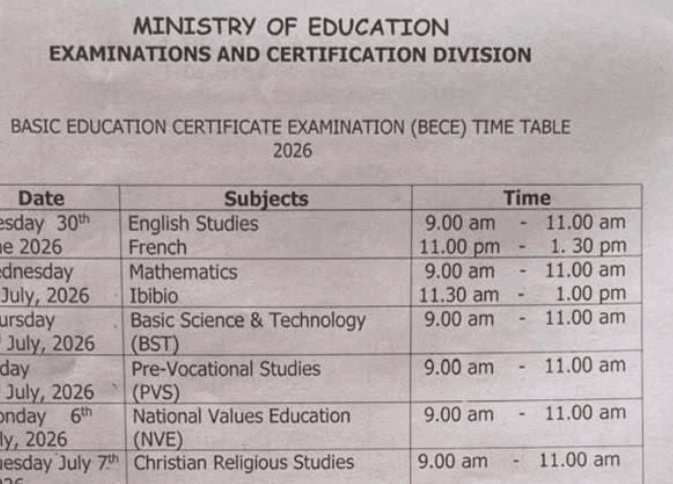
Akwa Ibom State Releases 2026 BECE Timetable for JSS3 Students
NECO Schedules 2026 BECE Re-sit Examination for July - Check Exam Dates Here