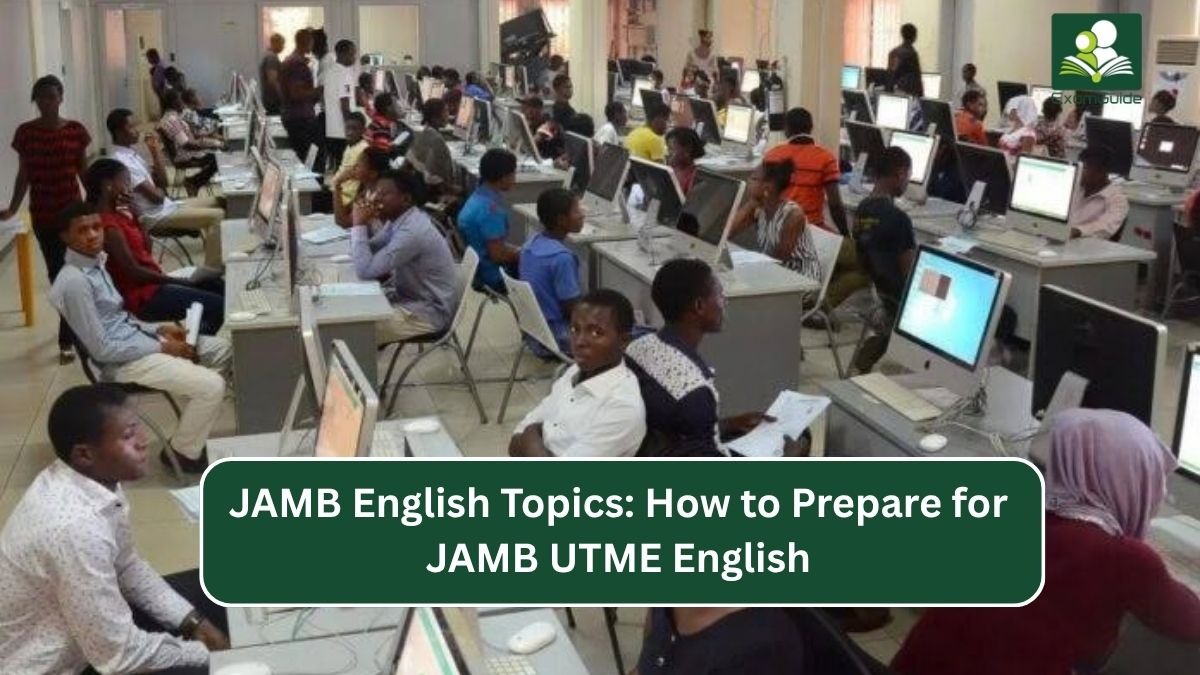
JAMB English Topics: How to Prepare for JAMB UTME English
English Language is one of the most important subjects in the JAMB Unified Tertiary Matriculation Examination because Use of English is compulsory for every UTME candidate, regardless of the course or institution they intend to study. JAMB's approved UTME subject list places Use of English among the examination subjects available to candidates, and the Board's official syllabus provides the areas candidates are expected to prepare for.
For many candidates, JAMB English can appear straightforward because they have studied English throughout secondary school. However, familiarity with the language does not automatically guarantee a high UTME score.
This guide breaks down the important JAMB English topics and explains how students can prepare for each area efficiently.
Candidates who want to turn these topics into regular practice can start their preparation with structured questions and explanations on → ExamGuide UTME
Table of Content
What Topics Should You Study for JAMB UTME English?
How Should You Prepare for Comprehension and Synthesis?
What Is Synthesis in JAMB English?
How Can You Improve Your Comprehension Skills?
Which Lexis and Structure Topics Should You Study?
How Should You Prepare for Synonyms and Antonyms?
Why Should You Study Concord and Other Grammar Topics?
How Important Are Idioms and Figurative Expressions?
Why Do Punctuation and Spelling Matter?
What Should You Study Under Oral Forms?
What Are Vowel and Consonant Sounds?
How Should You Prepare for Word Stress?
How Should You Prepare for the Prescribed Reading Text?
How Many JAMB English Questions Should You Practise?
How Should You Manage Your Time When Practising JAMB English?
What Study Plan Can You Use for JAMB English?
What Common Mistakes Should You Avoid in JAMB English?
How Can Parents Help Students Preparing for JAMB English?
How Can ExamGuide Help With JAMB English Preparation?
Frequently Asked Questions About JAMB English
What Topics Should You Study for JAMB UTME English?
The first step is to understand what the examination expects you to know. The official syllabus provides the framework for the topics candidates should prepare for, so your study plan should follow it rather than relying entirely on topics you happen to find easy or interesting.
The major areas to focus on are:
- Comprehension and Synthesis
- Lexis and Structure
- Oral Forms
- The prescribed reading text
These areas contain several smaller topics, so candidates should avoid treating "English" as one broad subject without a study plan.
The syllabus also explains the skills candidates should develop, including identifying meanings in context, understanding relationships between ideas, recognising grammatical structures, distinguishing sounds, and interpreting information from passages.
Understanding this structure gives you a much better starting point than simply searching for random JAMB English questions online.
How Should You Prepare for Comprehension and Synthesis?
Comprehension tests your ability to understand information contained in a passage. You may be required to identify the main idea, understand the meaning of a word or expression from context, identify the writer's purpose, draw conclusions or answer questions based on information presented in the passage.
Do not approach comprehension passages as though you have to memorise every sentence. Your goal is to understand what the passage is saying and locate the information needed to answer each question.
For example, consider this short passage:
Many students believe that studying for long hours automatically leads to better examination results. However, effective study depends not only on the amount of time spent but also on how that time is used. A student who spends two hours actively answering questions may learn more than one who spends five hours simply reading notes.
A question could ask:
According to the passage, what determines the effectiveness of studying?
- A. The number of hours spent studying
B. The amount of notes a student reads
C. How effectively the study time is used
D. The number of subjects studied
The answer is C because the passage specifically explains that effective studying depends on how the available study time is used.
This is why you should avoid choosing an option simply because it contains words you remember seeing in the passage. Read the question carefully and identify the idea that actually answers it.
What Is Synthesis in JAMB English?
Synthesis involves combining information from different parts of a passage to arrive at a complete understanding. The official syllabus describes synthesis as the process of combining distinct or separate pieces of information to form a complete whole.
For example, a passage may explain that regular revision improves memory, answering practice questions helps students identify weak areas, and timed practice improves speed. A synthesis question may ask you to identify the overall benefit of these activities.
You therefore need to understand the relationship between different ideas instead of searching for one sentence that looks exactly like an answer option.
How Can You Improve Your Comprehension Skills?
The best way to improve is through regular practice. Read passages from different subjects and practise answering questions without immediately checking the answers.
After answering a question, go back to the passage and identify the exact information that supports your answer. If you get a question wrong, do not simply memorise the correct option. Find out why your original answer was wrong.
Pay attention to words such as however, although, therefore, despite, because, while, consequently and in contrast. These words often show relationships between ideas and can help you understand the direction of an argument.
You should also practise identifying the meaning of unfamiliar words from context. You may not know every word in a passage, but you can often work out its meaning from the surrounding sentences.
Put your comprehension skills to the test with more practice questions. Practise on ExamGuide
Which Lexis and Structure Topics Should You Study?
Lexis and Structure covers a wide range of areas relating to vocabulary and grammatical usage. According to the JAMB syllabus, candidates should prepare for synonyms, antonyms, homonyms, clause and sentence patterns, word classes, tense, aspect, number, agreement or concord, degree, question tags, punctuation, spelling, ordinary usage, figurative usage and idiomatic usage.
This is one reason why simply reading novels may not be enough preparation for JAMB English. You need to practise specific language structures and understand how they are tested.
How Should You Prepare for Synonyms and Antonyms?
A synonym is a word that has a similar meaning to another word, while an antonym has an opposite meaning.
For example:
The principal commended the students for their excellent performance.
- A. criticised
B. praised
C. punished
D. questioned
The correct answer is B, praised. In this context, commended means praised.
For an antonym:
The manager was reluctant to approve the request.
- A. unwilling
B. hesitant
C. willing
D. doubtful
The correct answer is C, willing, because willing is opposite in meaning to reluctant.
When studying vocabulary, do not memorise words in isolation. Learn their meanings, how they are used in sentences and the words that commonly occur with them.
Why Should You Study Concord and Other Grammar Topics?
Grammar questions test whether you understand how words function together in sentences.
Concord, for example, deals with agreement between different parts of a sentence. One common area is subject and verb agreement.
Consider this question:
Neither the teacher nor the students ___ aware of the change.
- A. was
B. is
C. were
D. has
The correct answer is C, were.
The verb agrees with the subject closest to it, which is the plural noun students. Questions like this require you to understand the structure of the sentence rather than choose an answer based on what sounds familiar.
Other grammar areas to practise include tenses, aspects, word classes, sentence patterns, question tags and degrees of comparison.
For example:
By the time the examination started, the candidates ___ their revision.
- A. complete
B. have completed
C. had completed
D. are completing
The correct answer is C, had completed because the revision happened before another event in the past.
How Important Are Idioms and Figurative Expressions?
Idiomatic and figurative expressions are also included in the JAMB Use of English syllabus. Candidates need to understand expressions based on how they are used rather than interpreting every expression literally.
For example:
After failing the first examination, Chika decided to turn over a new leaf.
The expression means to change one's behaviour and make a fresh start.
If you interpret the expression literally, you may think it has something to do with turning a page or leaf. In an examination, however, the context is what determines the intended meaning.
Practise common idiomatic expressions and learn how they are used in sentences.
Why Do Punctuation and Spelling Matter?
JAMB can test whether you can recognise correct spelling and punctuation. Candidates sometimes overlook these areas because they appear simple, but small differences can change meaning or make a sentence grammatically incorrect.
You should revise commonly confused words and pay attention to punctuation marks such as commas, apostrophes, full stops, question marks and quotation marks.
For example:
The students books were on the table.
The sentence is incorrect because the possessive form of students requires an apostrophe:
The students' books were on the table.
The apostrophe shows that the books belong to the students.
What Should You Study Under Oral Forms?
Oral Forms is another important part of the JAMB Use of English syllabus. It covers vowels, consonants, consonant clusters, rhymes, homophones, word stress and intonation, including emphatic stress.
Candidates who are not familiar with phonetic symbols or sound distinctions may initially find this section difficult. The solution is regular practice rather than avoiding it.
What Are Vowel and Consonant Sounds?
Vowels are sounds produced without significant obstruction of the airflow, while consonants involve some degree of obstruction.
JAMB may ask you to identify words that contain the same or different sounds.
For example:
Choose the word that has the same vowel sound as seat.
- A. sit
B. beat
C. set
D. sat
The answer is B, beat because seat and beat contain the same vowel sound.
Do not rely only on spelling when answering Oral English questions. Two words may look similar but contain different sounds, while words with different spellings can sometimes have the same sound.
How Are Homophones Tested?
Homophones are words that have the same pronunciation but different meanings and spellings.
For example:
principle and principal
The two words are pronounced similarly, but their meanings are different. A principle is a fundamental rule or belief, while a principal can refer to the head of a school.
Understanding such distinctions can help you avoid mistakes in questions involving vocabulary and pronunciation.
How Should You Prepare for Word Stress?
Word stress refers to the emphasis placed on a particular syllable in a word.
For example, in PHOtograph, the first syllable receives the main stress.
Students should practise pronouncing words correctly rather than simply memorising which syllable is stressed. Listening to standard English pronunciation and repeating words aloud can help.
What Is Intonation?
Intonation refers to changes in the pitch of the voice when speaking. It can affect how a statement or question is understood.
For example:
"You are coming?"
When spoken with rising intonation, the speaker may be asking for confirmation.
Understanding stress and intonation requires listening practice. Reading about pronunciation without actually listening to and producing the sounds may not be enough.
How Should You Prepare for the Prescribed Reading Text?
The prescribed reading text should not be treated as something you read once and forget. JAMB has previously emphasised the importance of candidates studying the prescribed text for Use of English.
For the examination year you are preparing for, confirm the prescribed text from the current JAMB syllabus or official communication and study that specific text.
As you read, pay attention to:
- Major characters
- Character relationships
- Important events
- Setting
- Themes
- Conflicts
- Important conversations
- Reasons behind major actions
- Lessons or ideas presented in the text
Questions can test whether you remember what happened, understand why an event happened or recognise the significance of a character or situation.
For example, instead of simply asking what a character did, a question could ask why the character took a particular action. This means you need to understand the events and their context, not just memorise isolated facts.
How Many JAMB English Questions Should You Practise?
Practice is particularly important because the UTME is a computer based examination. JAMB's 2026 training manual states that Use of English is compulsory and consists of 60 multiple choice questions, while the other three selected subjects have 40 questions each.
Do not wait until a few weeks before the examination before you begin answering questions.
Start with individual topics. For example, spend one study session practising synonyms and antonyms, another on concord and tenses, and another on comprehension. Once you become comfortable with individual areas, combine them in full practice sessions.
This approach makes it easier to identify exactly where you are losing marks.
How Can Past Questions Improve Your JAMB English Preparation?
Past questions help you become familiar with the way questions are presented. They also expose you to different vocabulary, grammatical structures, comprehension passages and Oral English questions.
However, avoid simply memorising answers.
If you answer a question incorrectly, find out why. If the answer is a synonym, understand the meaning of the word. If it is a grammar question, identify the grammatical rule involved. If it is a comprehension question, return to the passage and identify the evidence.
You can strengthen this part of your preparation by using → ExamGuide to practise questions and identify areas where you need more work.
How Should You Manage Your Time When Practising JAMB English?
Time management should be part of your preparation, not something you begin thinking about on examination day.
When practising, occasionally set a timer and answer questions under examination conditions. This will help you learn how quickly you can work without sacrificing accuracy.
If a question is taking too long, move on and return to it later when appropriate. Spending too much time on one difficult question can reduce the time available for questions you could answer correctly.
Comprehension passages also require careful time management. Read efficiently, understand the central idea and return to the passage when a question requires specific information.
What Study Plan Can You Use for JAMB English?
A simple weekly structure can help you cover the syllabus consistently.
Monday: Synonyms, antonyms and vocabulary
Tuesday: Grammar, concord, tenses and sentence patterns
Wednesday: Comprehension and synthesis
Thursday: Oral Forms, including sounds, stress and intonation
Friday: Idioms, figurative expressions, punctuation and spelling
Saturday: Prescribed reading text and mixed practice
Sunday: Revision and correction of previously missed questions
You can adjust this schedule according to your other subjects and your personal study routine. The important thing is to cover all the major areas instead of repeatedly studying only the topics you already understand.
What Common Mistakes Should You Avoid in JAMB English?
One common mistake is studying only grammar. Although grammar is important, the syllabus covers several other areas, including comprehension, vocabulary, Oral Forms and the prescribed reading text.
Another mistake is choosing answers because they contain words that appear in the passage. In comprehension questions, an option can contain words from the passage and still be wrong.
Some candidates also ignore Oral English because they assume it is difficult. Avoiding a section of the syllabus means giving away opportunities to earn marks.
Another problem is failing to review mistakes. If you repeatedly answer questions without studying your errors, you may continue making the same mistakes.
Finally, do not rely entirely on last minute revision. Consistent practice gives you time to identify weak areas and improve them.
How Can Parents Help Students Preparing for JAMB English?
Parents can support candidates by providing a suitable study environment and encouraging consistency.
Rather than asking only, "How many hours did you study today?" ask questions such as, "What topic did you learn today?" or "Which questions did you get wrong?"
This shifts the focus from the number of hours spent studying to the quality of the preparation.
Parents can also encourage students to practise regularly and review their mistakes instead of waiting until examination dates are close.
How Can ExamGuide Help With JAMB English Preparation?
Preparing with the syllabus is important, but candidates also need opportunities to apply what they have learnt.
ExamGuide provides a platform where students can practise examination questions and strengthen their preparation through repeated practice. Candidates can use practice sessions to test their understanding, identify weak areas and become more comfortable with examination style questions.
Instead of studying English only by reading notes, combine your study with active question practice. After learning a topic such as concord, immediately answer questions on concord. After studying synonyms, practise identifying synonyms in different contexts.
You can continue your JAMB preparation through → ExamGuide's UTME practice platform and use regular practice to reinforce what you learn.
Final Thoughts
JAMB English becomes easier to prepare for when you understand exactly what you are expected to study.
Start with the official syllabus and organise your preparation around Comprehension and Synthesis, Lexis and Structure, Oral Forms and the prescribed reading text.
Do not study these areas only by reading notes. Answer questions, examine your mistakes, practise under time limits and return to topics where your performance is weak.
For example, if you consistently miss questions on concord, do not simply move on after checking the answers. Review subject and verb agreement, practise more questions and monitor whether your accuracy improves.
The same principle applies to comprehension, vocabulary, Oral English and every other part of the syllabus.
Frequently Asked Questions About JAMB English
1. Is English compulsory in JAMB UTME?
Yes. JAMB's UTME structure makes Use of English compulsory for candidates, alongside three other subjects selected according to their intended course and programme requirements.
2. What are the main topics in JAMB English?
The main areas in the official Use of English syllabus are Comprehension and Synthesis, Lexis and Structure, Oral Forms and the prescribed reading text.
3. Does JAMB English include comprehension passages?
Yes. Comprehension and Synthesis form a major part of the Use of English syllabus. Candidates should practise understanding passages, identifying main ideas, interpreting information and combining ideas from different parts of a text.
4. What should I study under Lexis and Structure?
You should study areas including synonyms, antonyms, homonyms, sentence patterns, word classes, tense, aspect, concord, degrees of comparison, question tags, punctuation, spelling, ordinary usage, figurative usage and idiomatic expressions.
5. Is Oral English part of JAMB Use of English?
Yes. The syllabus includes vowels, consonants, consonant clusters, rhymes, homophones, word stress and intonation.
6. Do I need to study the prescribed JAMB reading text?
Yes. Candidates should study the prescribed reading text for the examination year and pay attention to characters, events, themes, relationships and other important details.
7. How can I improve my JAMB English score?
Study according to the syllabus, practise questions regularly, review your mistakes, improve your vocabulary, read comprehension passages and practise Oral English. Consistent practice is more useful than relying entirely on last minute revision.
8. Should I practise past JAMB English questions?
Yes. Past questions can help you understand the style of questions and identify areas where you need more practice. However, focus on understanding why an answer is correct rather than memorising answers.
9. How much time should I spend studying JAMB English?
There is no single number of hours that works for every candidate. What matters is consistency and effective study. Include English in your weekly timetable and divide your time across the different syllabus areas.
10. Where can I practise JAMB English questions?
You can use ExamGuide UTME to practise examination questions and make question practice a regular part of your JAMB preparation.
No comment found
Related Posts

What Happens After Writing JAMB UTME? A Complete Guide from UTME Result to Admission
How JAMB CAPS Works: A Step-by-Step Guide to Accepting Your Admission Offer

JAMB Says "Old O’Level Uploads Remain Valid", Clarifies New Verification Method

JAMB Candidates Can Now Verify O'Level Results from Home

2026 Admission: JAMB Sets 80% Benchmark for UTME, Post-UTME Candidates for Underage Candidates